

Top Risks for Healthcare Organizations & Health Plans in 2026
As the regulatory landscape intensifies and technology adoption accelerates, health plans face a convergence of governance, compliance, and operational risks heading into 2026 and beyond. This briefing outlines the critical risk areas, priority focus areas for AHC clients, and how AHC's advisory capabilities can help your organization build defensible, scalable governance structures.
The 2026 Risk Landscape at a Glance
Five interconnected risk domains are converging to create significant exposure for health plans and healthcare organizations. Understanding how these risks interact is the first step toward building a resilient governance posture.
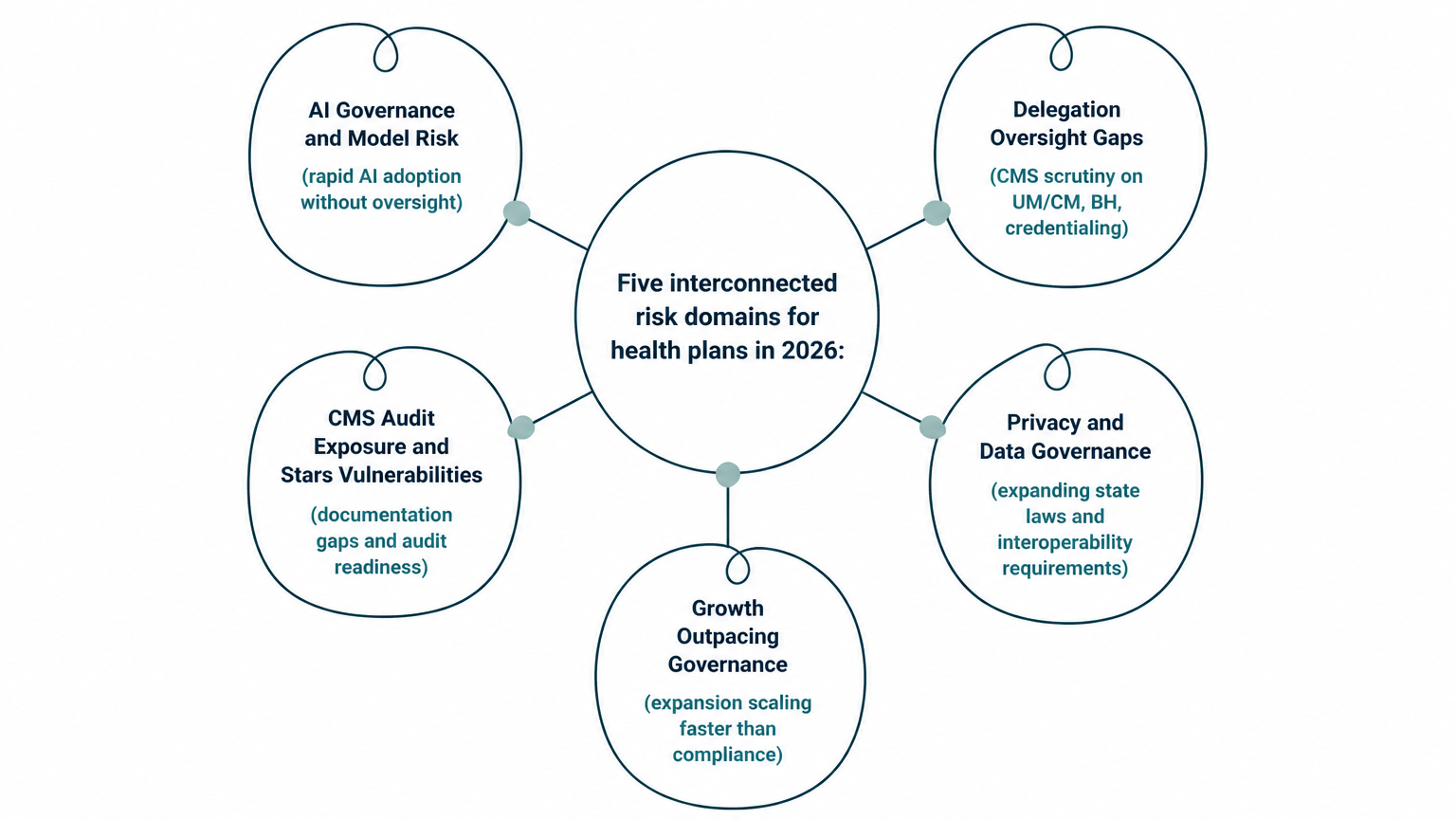
Each of these domains demands immediate leadership attention. The organizations best positioned for 2026 are those building integrated governance responses — not siloed, reactive fixes.

Risk #1: AI Governance & Model Risk
Rapid adoption of AI across various processes, including utilization management, claims processing, and member engagement has outpaced the governance structures needed to ensure accountability, transparency, and equity. Without adequate oversight, documentation, and bias controls, health plans face significant regulatory, reputational, and operational exposure.
Oversight Gaps
AI models lack formal validation, documentation, and accountability structures required by CMS and emerging federal guidance.
Bias & Equity risks
Unmonitored models may produce disparate outcomes across protected classes, creating civil rights and regulatory liability.
Human-in-the-loop failures
Automated decisions without sufficient human review undermine appeals processes and conflict with CMS expectations for clinical oversight.
Risk #2: Delegation Oversight Gaps
CMS has significantly increased scrutiny on how Medicare Advantage plans oversee delegated functions, including areas such as UM, care management, behavioral health, credentialing, and network operations. Many plans lack the consistent monitoring cadence and evidence-ready documentation needed to demonstrate compliant oversight during audits.
What CMS Is Looking For
Documented oversight of all delegated entities
Standardized monitoring schedules and evidence logs
Clear corrective action pathways and escalation protocols
Updated delegation agreements reflecting current requirements
Common Gaps Identified
Inconsistent oversight across UM, BH, and credentialing delegates
Outdated delegation agreements lacking current regulatory language
No centralized evidence library for audit response
Corrective action processes that are informal or undocumented
Risk #3: CMS Audit Exposure & Stars Vulnerabilities
Documentation gaps, inconsistent operational controls, and limited audit readiness continue to drive findings across Medicare Advantage programs. Stars performance is increasingly tied to revenue, and market competitiveness remains vulnerable when underlying operational controls are not consistently executed and evidenced.
Audit Risk
Broader and more frequent CMS audits mean organizations must maintain good status and audit-ready documentation.
FWA Program Gaps
Fraud, waste, and abuse programs require active monitoring, documented investigations, and clear escalation trails to satisfy CMS program requirements.
Stars Measure Controls
Stars performance depends on consistent operational execution, not just reporting. Gaps in care, adherence programs, and CAHPS processes create measurable score risk.
Risk #4: Privacy & Data Governance
The expanding patchwork of state privacy laws, combined with CMS interoperability mandates, is creating complex new obligations around PHI handling, vendor data flows, and data lineage. Health plans operating across multiple states face compounding compliance requirements that demand a modernized, proactive data governance posture.
State Privacy Law Complexity
Diverging state requirements for consumer health data, consent, and breach notification require ongoing legal and operational monitoring across jurisdictions.
Interoperability Requirements
CMS API mandates and data sharing obligations increase PHI exposure risk across member-facing applications, payer-to-payer exchanges, and analytics platforms.
Vendor Data Flow Risk
Third-party vendors handling PHI require robust BAA governance, access controls, and contractual data handling standards, often poorly documented today.
Risk #5: Growth Outpacing Governance
Market expansion, acquisitions, and the integration of new technologies are scaling faster than the compliance and operational governance structures designed to manage them. Without intentional governance design, growth creates blind spots — new markets without compliant workflows, acquired entities without governance integration, and technologies deployed without risk assessment.
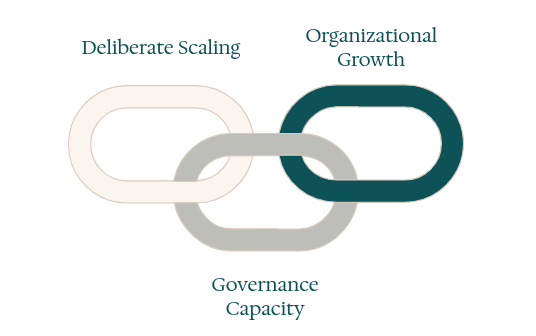
The path forward requires proactive governance design that anticipates organizational complexity — not reactive compliance retrofitting after growth has already occurred.
Priority Focus Areas for AHC Clients: 2027 Planning
Based on the 2026 risk landscape, AHC has identified five strategic priorities that health plan leaders should be actively building or strengthening now to establish defensible governance postures heading into 2027.
Defensible AI Governance Framework
Aligned with NIST AI RMF and CMS expectations — including documentation standards, bias testing protocols, and human-in-the-loop controls.
Delegation Oversight Strengthening
Standardized monitoring programs, updated delegation agreements, and clear corrective action pathways across all delegated functions.
Modernized Privacy & Data Governance
Data mapping, vendor oversight, access controls, and PHI protection strategies that support interoperability and analytics objectives.
Audit-Ready Documentation & Controls
Evidence libraries, operational controls, and Stars-aligned process documentation to reduce CMS findings and improve performance.
Scalable Governance Architecture
Policy modernization, operating model development, and cross-functional accountability structures designed to scale with organizational complexity.

How AHC Can Help
AHC brings deep operational and regulatory expertise to each of these risk domains. Our advisory capabilities are designed to meet health plans where they are — delivering practical, evidence-ready solutions that hold up under CMS scrutiny and drive measurable governance improvement. Learn more about AHC’s approach and commitment to practical, evidence-ready healthcare advisory solutions
AI Governance & Model Risk
Governance framework development, documentation standards, bias testing design, and human-in-the-loop control implementation aligned with NIST AI RMF and CMS guidance.
Delegation Oversight Support
Oversight program assessment and design, monitoring dashboards, delegate performance tools, and evidence-ready documentation libraries for audit response.
CMS Audit Readiness
Process documentation review, evidence library construction, corrective action planning, and comprehensive risk assessments tailored to MPSC, RADV, and Stars requirements.
Privacy & Data Governance
Data mapping, vendor governance frameworks, access control design, and PHI protection strategies that address both state privacy laws and federal interoperability obligations.
Scalable Governance Design
Policy modernization, operating model development, and cross-functional accountability structures that keep governance aligned with organizational growth and market expansion.
Additional AHC Capabilities
Beyond the five core risk areas, AHC offers a broader suite of advisory capabilities to address the full spectrum of operational and security risk facing health plans today.
Third-Party Risk Management
Vendor risk assessment frameworks, ongoing monitoring programs, and contractual governance structures for critical and high-risk vendors.
SOC 2 / HITRUST Preparation
Readiness assessments, gap remediation planning, and evidence preparation to support certification and audit success.
NIST & ISO Frameworks
Readiness assessments and formal risk assessments aligned with NIST CSF, NIST SP 800-53, ISO 27001, and related standards.
Cybersecurity Advisory
Security program assessments, incident response planning, and cybersecurity governance support tailored for health plan environments.
AHC's advisory approach is designed to integrate across all of these capability areas, delivering coordinated governance solutions rather than isolated engagements. Contact AHC to discuss how these capabilities can be tailored to your organization's 2026–2027 risk profile.

Let's Build Your 2026 Governance Roadmap
AHC's advisory team is ready to help your organization assess exposure, close gaps, and build defensible governance structures across all five risk domains. Reach out to your AHC advisor to get started.
Frequently Asked Questions About Healthcare Risk Management in 2026
-
Healthcare organizations and health plans are facing increasing risks across five key areas: AI governance, delegation oversight, CMS audit readiness, privacy and data governance, and scalable governance structures. These risks are interconnected, requiring organizations to move beyond reactive compliance efforts and build proactive governance programs.
-
AI adoption in healthcare is accelerating across areas such as utilization management, claims operations, and member engagement. Without appropriate governance structures, organizations may face risks related to transparency, accountability, bias, documentation, and regulatory compliance. Effective AI governance includes model oversight, validation processes, documentation standards, and human review controls.
-
Health plans can strengthen CMS audit readiness by establishing consistent operational controls, maintaining evidence-ready documentation, monitoring delegated functions, and creating clear corrective action processes. A proactive audit readiness program helps organizations identify gaps before they become findings during regulatory reviews.
-
Healthcare organizations are managing increasingly complex data environments due to expanding interoperability requirements, evolving privacy regulations, analytics initiatives, and third-party vendor relationships. Strong privacy and data governance programs help organizations understand data flows, protect protected health information (PHI), and establish appropriate controls for access and use.
-
Growth through expansion, acquisitions, and technology adoption can create new compliance and operational risks when governance structures do not scale alongside the organization. A strong governance framework helps healthcare organizations maintain accountability, standardize processes, and manage risk as complexity increases.
-
Organizations should focus on creating integrated governance programs that address AI oversight, compliance controls, vendor risk, privacy, cybersecurity, and operational accountability. Prioritizing these areas helps build a more resilient foundation for regulatory changes and future growth.